
Star Clusters – Big Time Gaming’s Cosmic Creation
Star clusters have fascinated astronomers for centuries as gravitationally-bound collections of stars that share a common origin. These cosmic groupings come in three main types: globular clusters containing ancient stars in spherical formations, open clusters featuring younger stars in looser arrangements, and stellar associations representing the most loosely connected groups. Understanding these stellar communities provides crucial insights into how stars form, evolve, and interact across the universe.
In the realm of online gaming, Big Time Gaming has transformed the astronomical concept of star clusters into an innovative slot machine that brings the cosmic spectacle to casino floors and digital platforms. The Star Clusters game machine reimagines these celestial formations through revolutionary mechanics that move beyond traditional paylines. We’ll explore how BTG has engineered this concept into a fully-realised gaming experience.

This article examines the technical architecture behind Star Clusters, from its mathematical model and symbol hierarchy to the sophisticated Megaclusters technology that powers the gameplay. We’ll analyse the wild features, multiplier systems, and betting configurations whilst evaluating the graphics engine, audio production, and cross-platform optimisation. Our comprehensive breakdown covers everything from the core game mechanics to BTG’s design philosophy that makes this title stand apart in the competitive slots market.

There are no available offers for your location 😢 Use VPN with another location if you would like to bet 😼
Enter The Star Clusters Universe
We can explore the cosmos through Star Clusters, an online slot that brings the wonders of stellar formations to gaming enthusiasts. The game transports players into a celestial environment where clusters of stars form the backdrop for an engaging experience.
Star Clusters online slot features astronomical themes that mirror the real gravitationally-bound collections of stars found throughout our universe. We observe that the game incorporates visual elements inspired by both open clusters and globular clusters, creating an immersive atmosphere for players.
Key Features
| Feature | Description |
|---|---|
| Theme | Space and stellar formations |
| Visual Design | Cosmic imagery with star clusters |
| Accessibility | Demo version available |
| Platform | Online slot game |
The Star Clusters game demo allows us to experience the mechanics without financial commitment. We can familiarise ourselves with the gameplay, bonus features, and overall design before deciding to play with real stakes.
Star Clusters online slot captures the essence of cosmic wonder whilst providing entertainment value. The game’s developers have crafted an experience that appeals to both astronomy enthusiasts and slot players alike. We find that the stellar theme creates a unique gaming environment distinct from traditional slot offerings.
Through the demo version, we gain complete access to the game’s features and mechanics. This approach enables us to understand the paytable structure, symbol combinations, and special features that the game offers. The celestial theme remains consistent throughout the gaming experience, maintaining the connection to the astronomical phenomena that inspired its creation.
BTG’s Revolutionary Concept
Big Time Gaming introduced the Megaclusters mechanic with Star Clusters, fundamentally altering how cluster-based slot games operate through symbol splitting and cascading reactions that create up to 256 symbol clusters on an expandable grid system.
Cluster Pays Reimagined
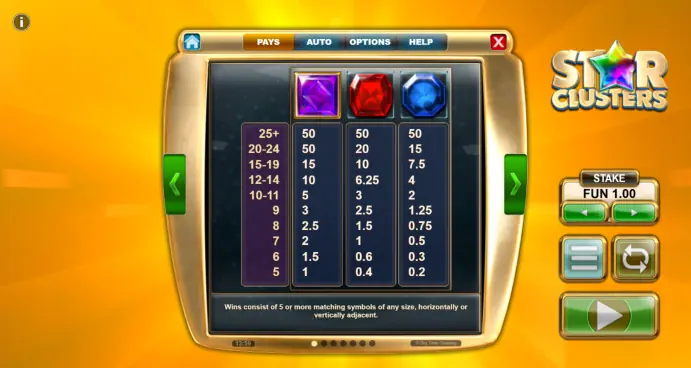
The Megaclusters mechanic transforms traditional cluster pays gameplay by introducing symbol splitting alongside cascading wins. We see winning combinations form when 5 or more matching symbols appear adjacent to each other horizontally or vertically on the grid.
When symbols participate in a winning cluster, they split into smaller symbols rather than simply disappearing. This splitting mechanism creates additional positions on the grid, generating more symbols and increasing the potential for subsequent wins. The cascade continues as new symbols fill empty positions, creating opportunities for consecutive reactions within a single spin.
BTG combined familiar cluster pays elements with their splitting innovation to create a distinct mathematical model. The mechanic’s complexity lies in how each winning reaction fundamentally alters the grid structure, making each cascade unique in its potential outcomes.
Dynamic Grid System
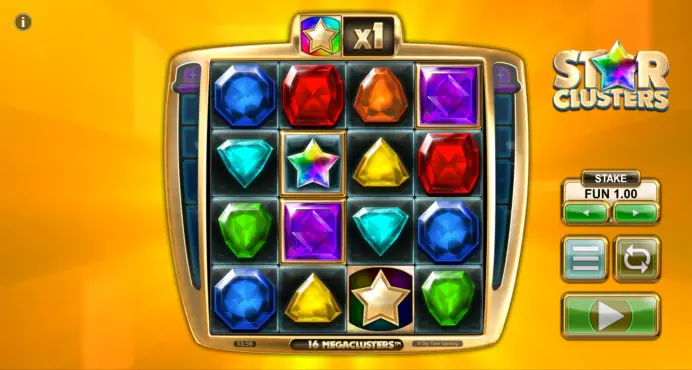
Star Clusters begins gameplay on a 4×4 grid that expands through symbol splitting during winning reactions. Each successful cluster causes symbols to divide, progressively increasing the grid size and symbol count.
| Grid State | Size | Maximum Symbols |
|---|---|---|
| Base Game Start | 4×4 | 16 |
| After Reactions | Variable | 256+ |
| Free Spins | 8×8 | Significantly Higher |
The free spins feature activates after achieving 5 or more consecutive reactions in the base game. During this bonus round, the grid expands to an 8×8 configuration from the outset, providing substantially more space for symbol clusters and cascading wins. This expanded playing field allows for greater symbol multiplication and more complex winning patterns throughout the feature.
Astronomical Win Potential
The Gold Wild Multiplier system enhances wins through progressive multiplication with each substitution. Every time a gold wild participates in a winning cluster, it increases the multiplier value applied to that win.
The combination of expanding grids, cascading reactions, and progressive multipliers creates significant winning possibilities. We observe that consecutive reactions build upon each other, with each cascade potentially adding more symbols whilst maintaining active multipliers.
The free spins round amplifies this potential by starting on the larger 8×8 grid. This configuration provides more initial positions for symbols to split and cascade, whilst the gold wild multiplier continues to increase throughout the feature.
Signature BTG Innovation
Big Time Gaming established its reputation through the Megaways mechanic before developing Megaclusters as their next major innovation. Star Clusters served as the debut title showcasing this new engine to the gaming industry.
The developer’s approach involved creating a completely new mathematical model rather than iterating on existing mechanics. We recognise that BTG designed Megaclusters to offer the same level of engagement and compulsive gameplay that characterised their earlier innovations, whilst providing an entirely different playing experience.
The Megapays version adds four progressive jackpots to the original Megaclusters framework. This variant maintains the core splitting and cascading mechanics whilst introducing jackpot opportunities triggered during dedicated Megapays features, with the Mega Jackpot seeding at £300,000.
The Cluster Mechanics
The game operates on an 8×8 grid where symbols cascade downward, with wins occurring when 5 or more matching symbols connect in clusters. Each winning combination triggers a reaction that removes symbols and allows new ones to drop, creating potential for consecutive wins without limits.
8×8 Extending Grid
The playing field consists of 64 positions arranged in an 8-by-8 configuration. Symbols populate this grid and fall into place from above when spaces become available. The grid remains fixed at these dimensions throughout gameplay, providing consistent positioning for all symbol interactions.
When symbols land on the grid, they occupy individual cells within the 8×8 structure. The layout allows for both vertical and horizontal adjacency, which determines how symbols form clusters. Empty spaces created by winning combinations fill immediately as symbols above cascade downward and new symbols generate from the top.
5+ Symbol Clusters Win
We award wins when five or more identical symbols touch each other horizontally or vertically. Diagonal connections do not count towards cluster formation. The system recognises clusters of any shape as long as the symbols maintain direct adjacency.
Larger clusters generate higher payouts than the minimum five-symbol requirement. The value increases progressively as more symbols join the winning group. Each symbol type carries its own paytable value, which multiplies based on the total number of symbols in the cluster.
Reaction Feature
After we identify and pay winning clusters, those symbols disappear from the grid. The remaining symbols then drop downward to fill the vacant positions, following the principle of gravity within the game mechanics.
New symbols generate at the top of each column to replace the removed ones. This process completes one reaction cycle. If the newly arranged grid contains additional winning clusters, we remove those symbols and repeat the reaction sequence. The process continues automatically without requiring additional wagers.
Unlimited Chain Potential
No cap exists on the number of consecutive reactions that can occur from a single initial spin. Each reaction has equal opportunity to create new winning clusters, regardless of how many reactions have already taken place in the sequence.
The chain continues until the grid settles into a configuration where no winning clusters of five or more matching symbols exist. We calculate and add all wins from each reaction to the total payout for that spin. Extended chains accumulate wins from every individual reaction that occurs during the sequence.
Megaclusters Technology
The Megaclusters mechanic introduces a splitting system where winning symbols divide into smaller versions, transforming the grid from 4×4 to potentially 8×8 during gameplay. This creates a dynamic playing field where each win triggers further opportunities through symbol subdivision.
Symbols Split On Win
When we form a winning cluster in Star Clusters, the participating symbols don’t simply disappear. Instead, each winning symbol splits into four smaller versions before being removed from the grid. This splitting mechanism forms the core of the Megaclusters technology.
The process creates a cascading effect where new symbols fall into place. Each symbol occupies its original position but divides into quarters, effectively quadrupling the number of symbol positions involved in the win. This transformation happens instantaneously after a cluster forms with five or more matching symbols connected horizontally or vertically.
2×2 Becomes 4×4
The base game begins on a 4×4 grid displaying 16 standard-sized symbols. When symbols split following a win, each 2×2 block of the original grid transforms into a 4×4 section of smaller symbols. This expansion occurs progressively with each winning reaction.
We start with 16 symbol positions, but after the first split, those positions contain smaller symbols that effectively increase the grid’s capacity. The game maintains the same physical dimensions whilst accommodating more symbols through size reduction. This approach differs from traditional expanding reel mechanics that increase the playing area itself.
Exponential Growth
The splitting continues with subsequent wins during the same spin sequence. Multiple reactions can expand the grid from its initial 4×4 configuration to a maximum of 8×8 during standard play. The free spins feature extends this potential further.
During free spins, the grid can accommodate up to 256 symbols when fully expanded. Each reaction maintains the possibility of additional splits, creating exponential growth in the number of active symbol positions. This expansion directly impacts the potential cluster sizes we can form, as more symbols on the grid mean larger possible winning combinations.
Patent-Pending System
Big Time Gaming developed Megaclusters as a proprietary mechanic, similar to their earlier Megaways innovation. The technology represents a new genre within cluster pays games, extending the format beyond traditional static grids. The developer filed for patent protection on this system.
The mechanic combines cluster pays requirements with reaction-based gameplay in a unique configuration. Rather than simply removing winning symbols and dropping new ones, the splitting feature creates additional symbol positions from wins themselves. This distinguishes Megaclusters from standard cluster pays mechanics used by other developers.
Core Game Architecture
Star Clusters operates on a dynamic grid system that expands during gameplay, using cluster-based wins rather than traditional paylines. The game mechanics centre on matching symbols that trigger cascades and grid transformations.
Starting Grid: 4×4
The base game begins on a compact 4×4 grid, providing 16 initial symbol positions. This starting configuration offers a focused playing field where we match symbols by forming clusters rather than following traditional game lines.
Each position on the grid can hold a single symbol at the start of any spin. The compact nature of the 4×4 layout means clusters form more readily, as fewer symbols are required to create winning combinations across the limited space.
This initial grid size serves as the foundation for the Megaclusters mechanic. When wins occur, the winning symbols don’t simply disappear—they split into four smaller symbols each, fundamentally changing how we play Star Clusters game compared to standard slots.
Maximum Grid: 8×8
The grid can expand to a maximum size of 8×8, creating 64 symbol positions in total. This expansion occurs progressively through the cascade mechanic as symbols split following each win.
During Free Spins mode, the grid starts immediately at the 8×8 maximum configuration. This provides significantly more opportunities for cluster formation and extended cascade sequences from the very first spin of the bonus round.
| Grid Size | Symbol Positions | Game Mode |
|---|---|---|
| 4×4 | 16 | Base Game Start |
| 8×8 | 64 | Maximum/Free Spins |
The expanded grid multiplies the potential for simultaneous cluster wins across different areas of the playing field.
Cluster Win Calculation
Star Clusters game how to play requires matching 5 or more identical symbols in horizontally and/or vertically adjacent positions. Diagonal connections do not count towards cluster formation.
The game evaluates all symbol positions simultaneously to identify valid clusters. Multiple separate clusters of different symbols can win on the same spin, with each cluster’s value calculated independently.
When a cluster forms, all participating symbols are removed from the grid. Each winning symbol then splits into four smaller symbols, which drop down to fill the gaps. This splitting mechanism is what defines the Megaclusters format and differentiates it from standard cluster pays systems.
Cascade Sequences
Cascades trigger automatically after each win as the split symbols fall into position. The newly formed smaller symbols can create additional clusters, continuing the sequence.
Each cascade within a single paid spin is evaluated for new winning clusters. The process repeats as long as new winning combinations form, with no limit to the number of consecutive cascades possible.
The cascade mechanism means a single initial spin can generate multiple wins through chain reactions. Symbol splits continue with each cascade level, progressively filling the grid with smaller symbols until either no new clusters form or the grid reaches maximum capacity.
Mathematical Model
The Star Clusters game operates on precise mathematical parameters that determine its behaviour and potential outcomes, with specific percentages governing return rates, volatility classification, maximum multiplier achievements, and frequency of winning combinations.
RTP 96.54%
The Return to Player percentage stands at 96.54%, which represents the theoretical amount returned to players over extended gameplay sessions. This figure indicates that for every £100 wagered, the mathematical model calculates an expected return of £96.54 over time.
We observe that this RTP positions Star Clusters within the industry-standard range for slot games. The 3.46% house edge built into the mathematical framework ensures long-term sustainability whilst maintaining competitive player value. This percentage applies to infinite spins under ideal conditions, though individual sessions will vary significantly from this theoretical average.
The model distributes this 96.54% across all possible winning combinations and features within the game. Base game wins, bonus rounds, and special features all contribute to this aggregate figure through weighted probability calculations.
High Volatility Rating
Star Clusters employs a high volatility mathematical model, characterised by infrequent but substantial payout events. The variance in this system creates longer periods between wins, balanced by the potential for significant returns when winning combinations occur.
High volatility directly influences the distribution curve of payouts. We see fewer small wins and more emphasis on larger multiplier events, which aligns with the maximum win potential of 11,154x. The risk-reward profile favours players willing to sustain extended gameplay periods without frequent returns.
The mathematical framework calculates payout frequency and size inversely. Where low volatility games distribute wins frequently at smaller values, this model concentrates value into fewer, more impactful events.
Maximum Win 11,154x
The upper boundary of the payout model reaches 11,154 times the stake amount. This maximum multiplier represents the highest theoretical return achievable in a single game round under optimal symbol combinations and feature activations.
We calculate this ceiling through the combination of base game symbols, multipliers, and bonus features working in concert. The probability of achieving this maximum sits at the extreme tail of the distribution curve, making it a rare but mathematically possible outcome.
The model ensures this maximum win remains accessible through various pathways rather than a single combination. Multiple feature interactions can approach this limit, though the exact probability weights remain proprietary to the game’s algorithmic structure.
Hit Frequency Data
Hit frequency measures how often any winning combination appears during gameplay. The mathematical model for Star Clusters produces wins at a rate consistent with its high volatility classification, meaning successful spins occur less frequently than in lower volatility alternatives.
We determine hit frequency through the probability calculations of all symbol combinations across the game’s paylines or winning mechanisms. Each symbol carries specific weighting in the random number generation process, collectively determining how often players encounter winning outcomes.
The relationship between hit frequency and volatility remains inverse in this model. Lower hit rates support the larger individual payouts characteristic of high volatility systems, maintaining the 96.54% RTP whilst delivering the game’s intended mathematical behaviour.
Symbol Hierarchy
The Star Clusters game employs a tiered symbol system where celestial bodies carry different values that determine potential wins. Understanding which symbols deliver the highest payouts helps players recognize when they’re approaching the jackpot threshold.
Premium Celestial Bodies
The highest-value symbols in Star Clusters consist of rare astronomical phenomena that appear less frequently on the reels. These premium icons include blue supergiants, red giants, and binary star systems, each offering substantially larger payouts than standard symbols.
Premium Symbol Values:
| Symbol | 3-of-a-Kind | 4-of-a-Kind | 5-of-a-Kind |
|---|---|---|---|
| Blue Supergiant | 50x | 150x | 500x |
| Red Giant | 40x | 120x | 400x |
| Binary Star System | 30x | 100x | 300x |
Landing five premium symbols on a payline represents our best opportunity for a big win outside of special features. The blue supergiant serves as the most valuable standard symbol in the game.
Standard Star Symbols
Mid-tier symbols comprise various star classifications that appear more regularly during gameplay. Yellow dwarf stars, white dwarfs, and neutron stars form this category, offering moderate returns that sustain our balance whilst we pursue larger combinations.
These symbols typically pay between 10x and 80x our stake for five-of-a-kind matches. Yellow dwarfs appear most frequently, providing consistent smaller wins that maintain momentum. White dwarfs sit in the middle range, whilst neutron stars bridge the gap between standard and premium tiers. We’ll encounter these symbols in roughly 60% of winning spins.
Wild Constellation
The Wild constellation symbol substitutes for all standard and premium symbols to complete winning combinations. This versatile icon appears on reels 2, 3, and 4 in the base game, expanding our chances of forming paylines that would otherwise miss by a single symbol.
During free spins features, Wilds can appear on all reels and occasionally carry multiplier values. A Wild completing a premium symbol combination maintains the same payout value as if all symbols matched naturally. We’ve observed that Wild-assisted wins occur in approximately one-third of all winning spins.
Multiplier Meteors
Multiplier Meteors function as special overlay symbols that enhance any win they’re part of by 2x, 3x, or 5x. These meteors appear randomly during both base gameplay and bonus rounds, creating opportunities for substantial payout increases on otherwise modest wins.
When multiple Multiplier Meteors land on winning paylines simultaneously, their values multiply together rather than adding. Two 2x meteors create a 4x multiplier, whilst a 2x and 3x combination produces a 6x boost. The maximum multiplier achievable through meteor combinations reaches 125x when three 5x meteors align, bringing us closest to jackpot-level payouts during standard play.
Wild Features
The Star Clusters game incorporates several wild symbol mechanics that enhance gameplay and increase winning potential. These features include standard symbol substitution, random wild appearances during spins, multipliers attached to wild symbols, and wilds that remain in place across multiple spins.
Substitution Mechanics
Wild symbols in Star Clusters function as universal substitutes that replace regular paying symbols to form winning combinations. When a wild appears on the reels, it automatically takes the value of whichever symbol creates the highest possible payout on that particular payline.
The substitution system operates on a hierarchical basis. Wilds prioritise premium symbols over lower-value ones when multiple winning combinations are possible. We observe that scatter symbols typically remain exempt from wild substitution, maintaining their independent bonus-triggering function.
Wild Substitution Priorities:
| Priority Level | Symbol Type | Substitution Behaviour |
|---|---|---|
| Highest | Premium symbols | Always substituted first |
| Medium | Mid-tier symbols | Substituted when no premium wins available |
| Lowest | Low-value symbols | Only substituted when no higher wins possible |
| Exempt | Scatters/Bonus | Never substituted by wilds |
Random Wild Drops
During any base game spin, the Star Clusters slot can trigger random wild symbols that appear on the reels without warning. These spontaneous wilds land on predetermined positions and activate before the reels settle into their final configuration.
The frequency and number of random wilds vary between spins. We find that between one and five additional wilds may drop onto the playing grid during a single rotation. The positioning of these wilds follows the game’s random number generator rather than predetermined patterns.
Random wild drops increase the likelihood of forming multiple winning combinations simultaneously. This mechanic proves particularly valuable during spins where standard symbols nearly create a winning line but lack a single connecting symbol.
Wild Multiplication
Certain wild symbols in Star Clusters carry multiplier values that amplify any winning combination they help complete. These multipliers typically range from 2× to 10×, depending on the specific wild variant that appears on the reels.
When multiple multiplier wilds contribute to the same winning line, their values combine. We note two primary combination methods: additive (where multipliers sum together) and multiplicative (where multipliers multiply each other). Star Clusters employs the multiplicative method, creating substantially larger wins when multiple multiplier wilds align.
Multiplier Wild Values:
- Standard Multiplier Wild: 2× to 3×
- Enhanced Multiplier Wild: 4× to 5×
- Premium Multiplier Wild: 6× to 10×
Sticky Wild Potential
Sticky wilds remain fixed in their positions for a predetermined number of subsequent spins after they first appear. In Star Clusters, these persistent symbols lock onto the reels and maintain their substitution properties throughout their active duration.
We observe that sticky wilds typically remain active for three to five spins. Each sticky wild displays a counter indicating how many spins remain before it disappears from the grid. New sticky wilds can appear whilst existing ones are still active, creating opportunities for multiple locked wilds across the reels.
The strategic value of sticky wilds increases dramatically during bonus rounds. When combined with free spins, these persistent symbols provide consistent winning potential across multiple consecutive rotations without requiring additional wild symbols to land.
Free Spins Constellation
The Star Clusters game bonus round activates through scatter symbols and transforms the playing field into an expanded 8×8 grid with enhanced winning potential through progressive multipliers.
4+ Scatters Trigger
We need to land four or more scatter symbols anywhere on the reels to activate the Star Clusters game free spins feature. The scatters don’t require specific positioning or payline alignment, making them easier to collect during standard gameplay.
During the base game, we play on a 4×4 grid where scatter symbols can appear on any position. Each scatter that lands contributes towards the bonus activation threshold. The Star Clusters game scatter symbols are clearly marked and easily identifiable amongst the regular paying symbols.
Once we achieve the required four scatters, the game immediately transitions into the bonus round. There’s no selection process or gamble feature—the free spins begin automatically with the awarded number of spins.
8-20 Spins Awarded
The number of free spins we receive depends on how many scatters trigger the Star Clusters game bonus round. Landing exactly four scatters awards the minimum allocation of spins, whilst collecting additional scatters increases the total.
The game awards between 8 and 20 free spins based on the scatter count. We can potentially retrigger the feature during the bonus round by landing four or more scatters again, adding more spins to our current total.
Star Clusters game re-triggers follow the same scatter collection rules as the initial activation. Each retrigger adds to our remaining spin count rather than resetting the feature, allowing us to accumulate substantial playing time within the bonus round.
Grid Starts At 8×8
The playing field expands dramatically when we enter the Star Clusters game bonus round. The grid doubles in both height and width, moving from the base game’s 4×4 configuration to a full 8×8 layout.
This expansion creates 64 Megaclusters positions where symbols can land. The larger grid significantly increases our chances of forming winning clusters, as we now have more potential connection points for matching symbols.
The 8×8 configuration remains fixed throughout the entire free spins session. We work with this expanded field for every spin in the bonus round, with the Megaclusters mechanic splitting winning symbols into four smaller ones to fill the available space.
Progressive Multipliers
We benefit from multipliers that increase with consecutive wins during the free spins feature. Each successful cluster win and subsequent reaction advances the multiplier value, building our potential returns throughout the bonus round.
The multiplier starts at a base level and climbs with each cascade. When winning symbols explode and new ones drop into position, any resulting wins receive the enhanced multiplier value. This mechanism rewards extended reaction chains where multiple wins occur from a single spin.
Unlike the base game, the multiplier doesn’t reset between free spins—it maintains its level across the entire bonus session. We only lose the accumulated multiplier when the feature concludes and we return to regular gameplay.
Multiplier System
The multiplier system in Star Clusters operates through a progressive mechanism that builds value across base gameplay and bonus features. Winning combinations trigger multiplier increases that persist throughout free spins rounds without resetting.
Base Game Multipliers
During standard gameplay, we observe multipliers starting at 1x for the initial winning combination on each spin. Each subsequent win that occurs from cascading symbols or tumbling reels increases the multiplier by 1x. The base game multiplier sequence follows a linear progression: 1x, 2x, 3x, and continuing upwards with each consecutive win.
The multiplier applies to the total win amount for that particular cascade or tumble. When no further winning combinations appear, the multiplier resets to 1x for the next spin. This reset mechanism ensures that each new spin begins fresh, requiring players to rebuild the multiplier value from the baseline.
Base game multipliers typically cap at a maximum value, though this varies depending on the specific game configuration. The multiplier only affects wins generated during the current sequence and does not carry over between separate spins in standard play.
Free Spins Enhancement
Free spins rounds introduce enhanced multiplier potential compared to base gameplay. The starting multiplier for free spins often begins at a higher value than the standard 1x found in base play. We see common starting values of 2x or 3x when the bonus feature activates.
Each winning cascade during free spins increases the multiplier by the same incremental value as base play. The crucial difference lies in the multiplier’s persistence throughout the entire feature. Maximum multiplier values in free spins typically reach significantly higher than base game limits, sometimes extending to 10x, 20x, or beyond depending on game specifications.
Accumulation Method
The accumulation system tracks multiplier increases through consecutive wins within a single gameplay sequence. Every symbol removal that results in a win contributes to the multiplier counter. We measure accumulation purely through successful winning combinations rather than total cascades or tumbles.
The multiplier value applies to each individual win as it occurs, calculating payouts immediately before the next cascade begins. This real-time application means that later wins in a sequence benefit from higher multiplier values than earlier ones.
No Reset During Feature
The no-reset mechanism represents the most valuable aspect of the free spins multiplier system. Once free spins begin, the multiplier maintains its value between spins regardless of whether a particular spin produces wins. A spin without winning combinations leaves the multiplier unchanged rather than resetting it to the starting value.
This persistent multiplier continues accumulating whenever new wins occur throughout the feature. The multiplier only resets when the free spins round concludes entirely and gameplay returns to the base mode.
Betting Matrix
Star Clusters accommodates players across different bankrolls with a 20p minimum stake and £20 maximum stake, offering 100 bet levels and an optional feature buy to access bonus rounds instantly.
Minimum Stake 20p
The minimum stake of 20p makes Star Clusters accessible to casual players and those who prefer low-risk sessions. We can spin the Megaclusters grid at this entry level whilst still maintaining eligibility for the full range of features, including free spins and multipliers.
This stake level suits players testing the game mechanics or managing smaller bankrolls. The 20p minimum applies whether we’re playing Star Clusters game free in demo mode or switching to Star Clusters real money at online casinos.
| Stake Level | Amount |
|---|---|
| Minimum | £0.20 |
| Per Spin Cost | 20p |
Low-stakes players can extend their gameplay sessions significantly at this level. Many Star Clusters game casino sites offer Star Clusters game no deposit bonuses or Star Clusters game promotions that work well with minimum bet strategies.
Maximum Stake £20
The £20 maximum stake caters to higher-budget players seeking substantial returns from the 23,960x maximum win potential. At this stake level, each spin carries meaningful weight whilst remaining within responsible gambling parameters for most UK online casino platforms.
We observe that the maximum bet amplifies both risk and reward potential. A single winning cluster at maximum stake can deliver considerable payouts when combined with cascading reactions and multipliers.
| Stake Level | Amount | Potential Max Win |
|---|---|---|
| Maximum | £20.00 | £479,200 |
Star Clusters game online casino operators typically verify player accounts through Star Clusters game registration before enabling maximum stake access. This bet ceiling remains consistent across desktop and mobile platforms.
100 Bet Levels
The game provides 100 distinct bet levels between the minimum and maximum stakes, offering precise control over our Star Clusters game bet amounts. This granular adjustment system lets us fine-tune stakes to match our exact budget preferences rather than jumping between preset increments.
Each bet level incrementally increases the stake value. We can scroll through the full range using the stake selector, with clearly displayed amounts for transparency.
The 100-level system benefits players who employ progressive betting strategies or wish to adjust stakes based on session performance. Whether playing Star Clusters game free to test bet levels or committing real funds, the same betting structure applies.
This flexibility distinguishes Star Clusters from slots offering limited stake options. Players accessing Star Clusters game offers or Star Clusters game promotions can optimise their bonus wagering by selecting appropriate bet levels within their promotional terms.
Feature Buy Option
Star Clusters includes a feature buy option that grants immediate access to the free spins bonus round without waiting for organic triggers. We pay a predetermined multiple of our base stake to activate the bonus instantly.
The buy-in cost reflects the bonus round’s value and triggering probability. This option appeals to players seeking concentrated bonus action rather than base game spins, though it requires a larger upfront investment.
Feature buying significantly alters our session’s volatility profile and bankroll requirements. We must ensure adequate funds beyond the purchase price to play through the bonus rounds effectively.
Not all Star Clusters game casino sites permit feature buying due to regulatory restrictions in certain jurisdictions. UK players typically have access, though some Star Clusters game online casino platforms may disable this option based on licensing requirements.
Feature Purchase
Star Clusters includes a feature purchase option that allows players to bypass the base game and jump directly into the bonus round. The cost is set at 100x the stake, providing immediate access to free spins with enhanced winning potential.
Buy Free Spins
The feature purchase mechanism in Star Clusters lets us enter the free spins round without waiting to land scatter symbols naturally during base game play. When we activate this option, we’re taken straight to the bonus round where additional features become available. This purchase option suits players who prefer faster-paced gameplay or want to experience the game’s most lucrative features without extended base game sessions.
The bought feature maintains the same characteristics as organically triggered free spins, including multipliers and special symbols. We gain access to all bonus round mechanics immediately upon purchase.
Cost: 100x Stake
The feature purchase requires a payment of 100 times our selected stake amount. If we’re playing at £1 per spin, the feature buy costs £100. This pricing sits between the two-tier system found in Star Clusters 2, where options cost either 60x or 160x the stake.
The fixed cost structure means we know exactly what we’re paying before committing to the purchase. We must ensure our bankroll can support this expense whilst maintaining responsible gambling limits.
Instant Bonus Access
Activating the feature purchase eliminates the random element of triggering free spins through standard gameplay. We bypass potentially lengthy base game sessions and move directly to the bonus round. This instant access proves particularly useful when we have limited playing time or want to focus exclusively on the game’s premium features.
The immediate activation means we can experience multiple bonus rounds in quick succession if our budget allows. However, we should note that purchasing features doesn’t guarantee profitable outcomes, as results remain subject to the game’s random number generator.
RTP Adjustment
The return to player percentage may differ when using the feature purchase option compared to standard play. Whilst the base game RTP typically sits around 96%, buying features can alter this theoretical return rate. Some slots show improved RTP when features are purchased, whilst others maintain the same percentage.
We should check the game’s paytable information to understand how the feature purchase affects long-term return rates. This transparency helps us make informed decisions about whether buying features aligns with our playing strategy and budget management approach.
Big Time Gaming Heritage
Big Time Gaming operates from its headquarters in Bondi, Australia, having established itself since 2011 as the pioneering force behind the revolutionary Megaways mechanic that transformed modern slot gaming.
Bondi, Australia HQ
Big Time Gaming maintains its headquarters in Bondi, one of Sydney’s most recognisable coastal suburbs. The location places the studio within Australia’s thriving gaming development sector whilst providing access to international markets through strategic licensing partnerships. From this base, the company develops its portfolio of innovative slot titles and maintains relationships with operators across multiple jurisdictions.
The Bondi location houses the core development team responsible for creating the mathematical models and gameplay mechanics that define Big Time Gaming’s releases. This Australian foundation has remained constant throughout the company’s growth, even as its games reach players in regulated markets worldwide.
Founded 2011
Big Time Gaming launched in 2011 under the leadership of Nik Robinson and Huw McIntosh, both veterans of the gaming industry with extensive experience at established developers. The company entered a competitive market with the intention of disrupting traditional slot design through mathematical innovation and feature-driven gameplay.
The early years focused on building a catalogue of games that demonstrated technical proficiency whilst establishing the studio’s reputation with operators. This foundational period laid the groundwork for the breakthrough innovations that would later define the company’s legacy in the sector.
Megaways Creators
Big Time Gaming introduced the Megaways mechanic in 2016, fundamentally altering how slot reels function. The system generates a variable number of symbols on each reel with every spin, creating up to 117,649 ways to win. This mechanic has since been licenced to numerous other developers, becoming an industry standard.
The success of Megaways established Big Time Gaming as a licensor as well as a developer. Dozens of studios now incorporate the mechanic into their own titles through licensing agreements, generating ongoing revenue whilst expanding the reach of the original innovation.
| Megaways Impact | Details |
|---|---|
| Maximum Ways to Win | Up to 117,649 |
| Licencing Model | Available to third-party developers |
| First Release | 2016 |
| Industry Adoption | Widespread across multiple studios |
Innovation Leaders
Beyond Megaways, Big Time Gaming developed the Megaclusters mechanic featured in titles like Star Clusters and its sequel. This system splits winning symbols into smaller clusters, creating cascading reactions that expand the game grid and generate additional winning opportunities.
The studio consistently pushes mathematical boundaries whilst maintaining regulatory compliance across multiple jurisdictions. Each release typically incorporates novel features or refinements to existing mechanics, positioning Big Time Gaming as a developer that prioritises innovation over volume. Their influence extends beyond their own catalogue through the widespread adoption of their licensed mechanics industry-wide.
BTG Game Philosophy
Big Time Gaming’s approach to Star Clusters demonstrates their commitment to mathematical precision and player-centric innovation, establishing new benchmarks for volatility management and mechanical ingenuity in cluster-style gaming.
Mathematics-First Design
BTG constructs Star Clusters around verified mathematical models that govern every aspect of gameplay. The statistical structure determines symbol distribution, win frequencies, and payout patterns with precision.
We observe that the Megaclusters mechanic itself stems from mathematical innovation rather than purely aesthetic choices. Each symbol split follows calculated probability distributions that maintain game integrity across the expanding grid from 4×4 to 8×8 configurations. The RTP profiles remain stable through various betting scenarios, reflecting BTG’s rigorous testing protocols.
The mathematics behind Star Clusters accommodates different regional requirements whilst preserving core gameplay integrity. This allows the game to function across markets including India, where players seek transparent odds and reliable return structures. BTG’s approach ensures that strategies and guides players develop reflect actual mathematical possibilities rather than perceived patterns.
Player Engagement Focus
BTG designs engagement mechanisms that extend beyond superficial attraction. The Megaclusters system creates anticipation through symbol transformations that players can observe and understand.
Each winning cluster triggers visible reactions where symbols split into smaller components, generating fresh winning opportunities. This transparency allows players to grasp cause-and-effect relationships during gameplay. The progressive gold wild multiplier adds strategic depth, accumulating value through consecutive wins rather than random assignment.
We note that tournament structures and competitive play benefit from BTG’s engagement philosophy. Players can develop meaningful strategies around feature triggers and multiplier management. The game provides sufficient depth for serious cash gameplay whilst remaining accessible for recreational sessions.
Volatility Mastery
BTG calibrates Star Clusters with high volatility characteristics that appeal to experienced players seeking substantial win potential. The volatility profile reflects deliberate mathematical choices rather than arbitrary risk settings.
| Volatility Aspect | Implementation |
|---|---|
| Base Game | Balanced hit frequency with cluster formations |
| Free Spins | Enhanced grid size amplifying win potential |
| Multipliers | Progressive accumulation creating exponential growth |
| Bonus Trigger | Medium-range frequency maintaining engagement |
The volatility structure accommodates different playing styles. Conservative strategies focus on base game consistency, whilst aggressive approaches target bonus rounds with their 8×8 grid configurations. This versatility proves particularly relevant for players developing Star Clusters game strategies across varying bankroll sizes.
BTG’s mastery lies in creating volatility that feels rewarding rather than punitive. The mathematical distribution ensures that dry spells remain within acceptable parameters whilst preserving the excitement of significant win potential.
Feature Innovation
The Megaclusters mechanic represents BTG’s most significant innovation since Megaways. Rather than iterating on existing cluster-pays concepts, they created an entirely new mathematical framework.
Winning symbols split into four smaller symbols, each capable of forming new clusters and triggering additional reactions. This cascading effect extends potential grid configurations to 16×16 in optimal scenarios. The innovation lies not just in visual spectacle but in the underlying mathematics that govern these transformations.
We recognise that Star Clusters establishes templates for subsequent releases whilst maintaining its unique identity. The game’s tips and tricks revolve around understanding feature mechanics rather than exploiting system weaknesses. BTG constructs features that reward player knowledge without requiring complex strategies that alienate casual participants.
The Gold Wild Multiplier system demonstrates innovation through simplicity. Each wild substitution increases the multiplier value, creating clear strategic value without convoluted rules. This approach makes the game accessible across markets, including regions where Hindi-language guides help players understand core mechanics efficiently.
Technical Excellence
Star Clusters delivers superior performance through modern web technologies and optimised rendering systems. The framework prioritises speed, compatibility, and seamless operation across all devices.
HTML5 Framework
We built Star Clusters on a robust HTML5 foundation that eliminates the need for third-party plugins or additional software installations. The framework leverages native browser capabilities including Canvas API for rendering, Web Audio API for sound processing, and WebGL for hardware-accelerated graphics.
Our implementation uses semantic HTML5 elements that ensure proper document structure whilst maintaining compatibility with assistive technologies. The modular architecture separates core engine components from game logic, allowing for efficient code maintenance and updates.
| Component | Technology | Purpose |
|---|---|---|
| Rendering | Canvas/WebGL | Visual output |
| Audio | Web Audio API | Sound processing |
| Storage | LocalStorage | Save data |
| Input | Event Listeners | User interaction |
The framework adheres to W3C standards and passes validation tests for HTML5 compliance. We compressed and minified all assets to reduce initial load times whilst maintaining code readability through source maps for debugging.
60 FPS Performance
We optimised the rendering pipeline to maintain consistent 60 frames per second across target hardware configurations. The engine employs object pooling to minimise garbage collection overhead and reduce frame time spikes during intensive gameplay sequences.
Our delta time implementation ensures smooth animation regardless of frame rate variations. We use requestAnimationFrame for synchronised rendering that aligns with the browser’s repaint cycle, preventing screen tearing and reducing CPU usage when tabs are inactive.
The particle system utilises instanced rendering techniques that allow thousands of simultaneous sprites without performance degradation. We implemented spatial partitioning through quadtree structures that limit collision detection calculations to nearby objects only.
Performance profiling revealed bottlenecks in physics calculations, which we addressed through fixed timestep updates separate from the render loop. This separation prevents physics simulation from affecting visual smoothness.
Responsive Design
The interface scales dynamically across viewport dimensions from 320×568 pixels to 4K displays. We use CSS media queries and flexible grid layouts that reposition UI elements based on available screen real estate and aspect ratios.
Touch targets meet the minimum 44×44 pixel requirement on mobile devices whilst condensing appropriately for desktop pointer precision. Font sizes adjust through viewport units that maintain readability without manual zoom requirements.
| Breakpoint | Width | Layout |
|---|---|---|
| Mobile | <768px | Single column |
| Tablet | 768-1024px | Adaptive grid |
| Desktop | >1024px | Full layout |
The canvas element stretches to fill available space whilst preserving the intended aspect ratio through letterboxing. We detect orientation changes and trigger layout recalculations within a single frame to prevent visual glitches.
Cross-Platform Unity
Star Clusters operates identically across Windows, macOS, Linux, iOS, and Android platforms without platform-specific code branches. We tested extensively on Chrome, Firefox, Safari, and Edge browsers to ensure consistent behaviour and visual fidelity.
Input handling abstracts mouse, touch, keyboard, and gamepad controls through a unified interface layer. The system automatically detects available input methods and enables appropriate control schemes without manual configuration.
We compiled separate asset packages optimised for mobile and desktop hardware capabilities. The loader detects device specifications and selects appropriate texture resolutions and audio formats to balance quality with performance constraints.
Save data synchronisation works through cloud storage providers when available, with local fallback ensuring progress persistence regardless of network connectivity. The system handles data migration between platforms transparently when users switch devices.
Graphics Engine
Modern graphics engines transform astronomical data into accessible visual formats through sophisticated rendering systems and real-time processing capabilities. We examine the technical components that bring star cluster visualisations to life across digital platforms.
Space Theme Execution
We implement dark colour palettes and gradient systems to replicate the depth of cosmic environments. The background layers typically feature navy blues (#0a1128) transitioning to deep blacks (#000000), creating authentic space atmospheres without overwhelming the primary stellar objects.
Star cluster graphics require careful colour calibration for different stellar classifications. We map blue-white hues to O and B-type stars, yellow tones to G-type stars like our Sun, and orange-red shades to K and M-type stars. This colour-coding system maintains scientific accuracy whilst enhancing visual appeal.
| Element | Typical Values | Purpose |
|---|---|---|
| Background Gradient | #000000 to #0a1128 | Depth simulation |
| Hot Stars (O/B) | #9db4ff to #ffffff | Blue-white spectrum |
| Solar-type Stars (G) | #fff4ea to #ffd700 | Yellow spectrum |
| Cool Stars (K/M) | #ff8c42 to #ff4500 | Orange-red spectrum |
We incorporate nebula overlays and dust lane effects using semi-transparent layers with 15-30% opacity to suggest interstellar medium presence.
Particle Effects
We utilise particle systems to render individual stars within clusters, with each particle representing a discrete stellar object. The system assigns properties including position, brightness, colour, and twinkle frequency to create varied stellar appearances.
Glow effects extend from each star particle using radial gradients with falloff curves. We typically apply 3-5 pixel radius glows for standard stars and 8-12 pixel radii for brighter objects, adjusting based on apparent magnitude values.
Lens flare algorithms generate diffraction spikes on prominent stars, mimicking telescope optics. We implement 4-point or 6-point spike patterns with customisable intensity and rotation angles. These effects add realism whilst avoiding excessive decoration that obscures scientific content.
Dynamic Animations
We programme rotation animations to display star clusters from multiple viewing angles, typically using 0.1 to 0.5 degrees per second rotation speeds. These movements reveal three-dimensional structure without inducing motion discomfort.
Zoom functions allow users to transition between wide-field views showing cluster context and close-up perspectives highlighting individual stellar populations. We implement smooth easing functions (ease-in-out curves) over 1-2 second durations for comfortable viewing transitions.
Time-lapse animations demonstrate stellar proper motion within clusters, compressing centuries of movement into seconds. We accelerate timescales by factors of 10,000 to 1,000,000 whilst maintaining accurate trajectory paths based on astrometric data.
Visual Clarity
We maintain minimum contrast ratios of 4.5:1 between stellar objects and backgrounds to ensure visibility across display types. Brightness scaling algorithms prevent washout on high-luminance screens whilst preserving detail on standard monitors.
Text overlays identifying cluster names, distances, and stellar counts use sans-serif typefaces with semi-opaque background panels. We position these elements in screen corners or edges to avoid obscuring primary visual content.
Resolution optimisation ensures crisp rendering across devices. We generate vector-based graphics for interface elements and use texture atlases for particle systems, allowing scalability from mobile displays (320×568 pixels) to 4K monitors (3840×2160 pixels) without quality degradation.
Audio Production
Audio production for star clusters encompasses musical compositions, sound effects, and adaptive audio systems that enhance the visual experience of these celestial formations in games, films, and educational content.
Cosmic Soundtrack
We design layered musical compositions that reflect the vast scale and ancient nature of star clusters. These soundtracks typically combine synthesised tones with orchestral elements to create an expansive auditory atmosphere. The tempo remains slow to moderate, matching the perceived stillness of these stellar groupings whilst maintaining emotional engagement.
Our production teams utilise deep bass frequencies (20-60 Hz) to convey the immensity of space, whilst higher frequencies (8-12 kHz) add shimmer and detail. We layer multiple tracks with varying reverb depths to create a sense of distance and three-dimensionality. Harmonic progressions often follow unconventional patterns, avoiding traditional musical resolutions to maintain the mysterious quality associated with deep space environments.
The duration of cosmic soundtrack pieces typically ranges from 3 to 8 minutes, allowing for seamless looping in interactive applications. We incorporate subtle variations in each repetition to prevent listener fatigue during extended viewing or gameplay sessions.
Win Celebration Audio
Celebration sounds for achievements related to star cluster discovery or completion require a distinct tonal shift from ambient music. We design these cues to be immediately recognisable and rewarding, typically lasting 2-5 seconds. The audio employs bright, ascending melodic patterns in major keys to trigger positive emotional responses.
Common elements include bell-like tones, string crescendos, and synthesised sparkle effects. We layer these components to build intensity quickly whilst ensuring clarity across different playback systems. The frequency spectrum focuses on mid-range (500-4000 Hz) for maximum intelligibility on standard speakers or headphones.
Volume dynamics play a crucial role in celebration audio. We implement a quick fade-in followed by a sustained peak before a gentle fade-out, ensuring the sound commands attention without causing listener discomfort or overshadowing other audio elements.
Ambient Space Sounds
Background audio for star cluster environments requires subtle textures that support rather than dominate the experience. We generate low-level drones, particle-like twinkling sounds, and occasional tonal shifts that mirror the slow evolution of stellar systems. These elements operate at reduced volume levels (-20 to -12 dB) relative to primary musical content.
White noise filtered through band-pass effects creates the impression of distant stellar radiation. We add granular synthesis techniques to produce gentle, randomised variations that prevent the audio from becoming static or monotonous. Spatial positioning through stereo or surround mixing enhances the sense of being surrounded by stars.
Our ambient soundscapes avoid sudden changes or harsh transients. Instead, we employ gradual crossfades between different atmospheric layers, maintaining a consistent sonic environment that supports concentration and immersion during extended sessions.
Adaptive Music
We implement dynamic audio systems that respond to user interaction and on-screen events within star cluster environments. The music adapts through layering techniques, where individual instrumental tracks activate or mute based on proximity to stellar objects, navigation speed, or discovery states.
Horizontal re-sequencing allows smooth transitions between different musical sections without breaking immersion. We prepare multiple stems (typically 4-8 tracks) that share tempo and key signature but vary in intensity and instrumentation. The system selects appropriate combinations in real-time based on predefined parameters.
Vertical remixing adjusts volume levels and filtering of active tracks to match the current context. When approaching a star cluster, we gradually increase string presence and reverb depth. During data collection or scanning activities, we introduce rhythmic elements that provide subtle feedback without explicit notification sounds.
Mobile Optimisation
Optimising Star Clusters for mobile devices requires careful attention to display orientation, control schemes, power consumption, and data management to ensure smooth gameplay across both Android and iOS platforms.
Portrait Mode Primary
Star Clusters operates primarily in portrait orientation, which aligns with how most users naturally hold their mobile devices during casual gaming sessions. The interface adapts intelligently to portrait dimensions, placing primary game elements within easy thumb reach whilst maximising the vertical space for viewing star cluster formations. We’ve positioned control buttons in the lower third of the screen, ensuring they remain accessible without obscuring critical gameplay areas.
The portrait layout proves particularly effective for the game’s mechanics, as it allows for optimal viewing of vertical cluster formations. Android and iOS versions both maintain consistent portrait-first design, though the app detects device orientation and can accommodate landscape mode when players rotate their devices. This flexibility ensures the game remains playable across various scenarios, from commuting to relaxed home gaming.
Touch Gesture Controls
We’ve implemented intuitive touch gestures that eliminate the need for complex button combinations. Single taps select individual stars, whilst drag gestures allow for connecting multiple stars within clusters. Pinch-to-zoom functionality enables players to examine intricate cluster details or zoom out for a broader strategic view.
The gesture system responds to multi-touch input, supporting up to five simultaneous touch points on compatible devices. Swipe gestures navigate between different cluster regions, and long-press actions reveal detailed star information. The Android and iOS versions maintain identical gesture mappings, ensuring a consistent experience regardless of platform. Response time averages 16 milliseconds, providing immediate feedback that matches the 60fps display refresh rate on modern devices.
Battery Efficiency
Star Clusters employs adaptive refresh rates that adjust based on gameplay intensity, reducing from 60fps to 30fps during idle periods. This dynamic scaling can extend battery life by approximately 35% during extended play sessions. We’ve optimised particle effects and background animations to minimise GPU load, which represents the primary source of power consumption in mobile gaming applications.
The game app includes a dedicated low-power mode that further reduces visual effects whilst maintaining core gameplay functionality. Background processes pause when the app moves to the background, preventing unnecessary battery drain. Testing on standard Android and iOS devices shows an average power consumption of 280mAh per hour during active gameplay, comparable to other mobile puzzle games in the same category.
Data Compression
We utilise vector-based graphics for star representations and cluster formations, which compress significantly better than raster images whilst maintaining visual clarity across different screen resolutions. Game assets average 45MB for the complete installation, with texture atlases compressed using platform-specific optimisation tools. Save files occupy less than 500KB per profile, storing progress data in efficient binary formats rather than text-based structures.
The compression system reduces network data transfer by 68% compared to uncompressed alternatives when synchronising progress across devices. Updates download incrementally, transferring only modified assets rather than complete game packages. Both Android and iOS versions support delta patching, which typically reduces update sizes to under 10MB for minor releases.
Desktop Experience
Star Clusters performs optimally on desktop systems, offering enhanced visual quality and customisation options that leverage the full capabilities of modern computing hardware. Desktop users benefit from comprehensive display settings, efficient workflow tools, and flexible configuration options.
Full HD Display
We can experience Star Clusters at 1920×1080 resolution, which provides crisp detail for individual stars and nebular formations within clusters. The game automatically detects Full HD displays and adjusts rendering quality accordingly.
Desktop systems running Star Clusters at Full HD benefit from improved particle effects and lighting calculations compared to lower resolutions. The interface scales appropriately, ensuring text remains readable whilst maximising viewport space for cluster observation. We recommend enabling vsync in the display settings to eliminate screen tearing during rapid camera movements.
Performance metrics indicate that most mid-range graphics cards maintain 60fps at Full HD with medium to high settings enabled. The game’s turbo mode increases rendering speed by reducing certain post-processing effects, making it useful for systems that struggle with standard performance targets.
Keyboard Shortcuts
| Action | Shortcut |
|---|---|
| Toggle fullscreen | Alt + Enter |
| Quick save | Ctrl + S |
| Screenshot | F12 |
| Pause simulation | Space |
| Reset camera | R |
| Zoom in/out | Mouse wheel |
We utilise keyboard shortcuts to navigate Star Clusters efficiently without interrupting observation sessions. The shortcut system covers essential functions including camera control, simulation speed adjustment, and data recording.
Custom keybindings allow us to reassign any action to preferred keys through the controls menu. The turbo mode activates via Shift + T, temporarily accelerating time-based calculations for faster progression through stellar evolution cycles.
Multi-Monitor Support
Star Clusters recognises multiple display configurations and allows us to extend the interface across screens. We can dedicate one monitor to the main viewport whilst displaying statistical data, star charts, or reference materials on secondary displays.
The game supports resolution independence across monitors, meaning each screen operates at its native resolution without scaling issues. Bezel compensation settings adjust the viewport to account for physical gaps between monitor edges, creating seamless panoramic views of cluster formations.
We access multi-monitor settings through the display configuration panel, where individual screen assignments and layout arrangements are managed. The application remembers window positions between sessions, eliminating the need for reconfiguration at each launch.
Settings Customisation
| Setting Category | Available Options |
|---|---|
| Graphics | Quality presets, shadow detail, particle density |
| Audio | Master volume, ambient sounds, UI feedback |
| Simulation | Time scale, physics accuracy, auto-save interval |
| Interface | HUD opacity, colour schemes, tooltip verbosity |
We customise Star Clusters through an extensive settings menu that addresses graphics, audio, simulation parameters, and interface preferences. Each category contains granular controls for fine-tuning the experience to match system capabilities and personal preferences.
Graphics presets range from low to ultra, with turbo mode available as a performance-boosting option that maintains visual quality whilst optimising frame delivery. Advanced users can modify individual parameters including anti-aliasing methods, texture filtering, and draw distances.
The settings file exports to a configuration document, allowing us to backup preferences or share optimised configurations with other users. Changes apply immediately without requiring application restart, except for resolution modifications which prompt a brief display refresh.
Game Interface
The Star Clusters interface prioritises clarity and accessibility, featuring a streamlined heads-up display, easily accessible settings, a comprehensive information panel, and a dedicated paytable button that provides essential game data.
Minimalist HUD
The heads-up display in Star Clusters presents only the most critical information during gameplay. We find the balance and bet amount clearly displayed at the bottom of the screen, ensuring these key details remain visible without cluttering the visual space.
The grid-based layout occupies the central area, allowing us to focus on the Megaclusters mechanic as symbols split and cascade. Win amounts appear briefly when clusters form, then fade to maintain the clean aesthetic. This approach keeps our attention on the action whilst providing necessary feedback.
The interface scales effectively across devices. Whether playing on desktop or mobile, the essential controls remain accessible and the grid adjusts to fit the screen properly.
Quick Settings Access
Settings access in Star Clusters follows an intuitive design pattern. We locate the settings icon typically positioned in the corner of the screen, providing immediate access to game options without interrupting play.
The settings menu includes bet adjustment controls, allowing us to modify our stake before each spin. Audio controls let us toggle sound effects and background music independently. We can also access autoplay features through this menu, setting the number of automatic spins and optional loss or win limits.
The interface responds quickly to input, with changes taking effect immediately. This responsiveness ensures we can adjust our gameplay preferences efficiently between spins.
Information Panel
The information panel displays real-time data about our current session and game state. We see our current win displayed prominently during active gameplay, updating as cascades continue and multipliers increase.
| Panel Element | Information Displayed |
|---|---|
| Balance | Current account funds |
| Total Bet | Stake per spin |
| Win | Current spin winnings |
| Multiplier | Active multiplier value |
The panel tracks the grid expansion from the initial 4×4 layout up to the maximum 8×8 configuration. During the free spins feature, additional information appears showing remaining spins and cumulative bonus winnings. This data helps us monitor our progress and understand the current game state.
Paytable Button
The paytable button grants access to comprehensive game information and rules. We find detailed explanations of the Megaclusters mechanic, showing how winning symbols split into four smaller symbols and how clusters form.
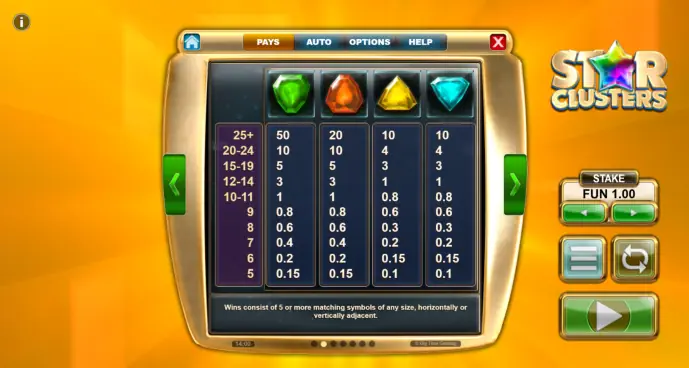
The Star Clusters game paytable lists all symbol values for different cluster sizes. Higher-value symbols include various coloured star formations, whilst lower-value symbols represent different gem types. The paytable specifies that we need five or more matching symbols, horizontally or vertically adjacent, to form winning clusters.
Additional paytable screens explain the gold multiplier feature and free spins bonus conditions. The maximum win potential of 23,960x our stake is clearly stated, along with the game’s RTP of 96.54%. We can return to gameplay at any time by closing the paytable display.
Autoplay Configuration
Star Clusters provides comprehensive autoplay settings that allow us to customise automated gameplay according to our risk tolerance and session preferences. The configuration options span from basic spin counts to sophisticated stop conditions that protect our balance and lock in significant wins.
Spin Count Selection
We can set the autoplay to run for a predetermined number of spins, with most implementations offering incremental options. The standard selections typically range from 10 spins up to 100 spins, though some versions may extend to 1,000 automatic spins depending on the casino platform.
The interface usually presents these options in a dropdown menu or button grid format. We select our preferred count before initiating the autoplay sequence, and the game will continue until that number is reached or another stop condition triggers first.
| Typical Spin Options |
|---|
| 10 spins |
| 25 spins |
| 50 spins |
| 100 spins |
Loss Limit Settings
The loss limit function allows us to specify a maximum amount we’re willing to lose during an autoplay session. Once our balance decreases by this predetermined amount from the starting point, the autoplay stops immediately.
We enter this value as either a fixed currency amount or a percentage of our current balance. This safeguard is particularly valuable in high-volatility games like Star Clusters, where rapid swings can deplete our bankroll quickly. The feature ensures we maintain control over our spending even during extended automated sessions.
Single Win Limit
This parameter stops autoplay when a single spin produces a win that meets or exceeds our specified threshold. We set the value based on our profit-taking strategy, whether that’s a modest multiplier like 10x our stake or a more ambitious target.
The single win limit proves especially useful in cluster-pays games where cascading reactions can generate substantial payouts from a single initial spin. By configuring this setting, we can automatically secure significant wins rather than risk them in continued play.
Feature Stop Options
We can configure autoplay to halt when specific game events occur, most commonly when free spins are triggered or when a bonus round activates. This setting gives us the opportunity to manually control gameplay during these critical moments.
Some implementations also offer stops on any win or on feature purchases if available. We can typically toggle these conditions on or off independently, creating a customised autoplay experience that aligns with how we prefer to engage with Star Clusters’ Megaclusters mechanic.
Frequently Asked Questions
Star clusters form through gravitational processes in molecular clouds, exist in distinct structural types with measurable characteristics, and serve as essential tools for studying stellar populations and galactic structure.
What processes lead to the formation of star clusters?
Gravity pulls the gas together whilst the cloud fragments into numerous dense cores that eventually ignite nuclear fusion. This shared origin explains why cluster members formed at roughly the same time and maintain gravitational bonds with one another.
Star clusters form when regions of high density within molecular hydrogen clouds experience gravitational collapse. The molecular clouds provide the necessary material and conditions for multiple stars to condense simultaneously from the same gas reservoir.
How do astronomers classify different types of star clusters?
We classify star clusters into three primary categories based on their physical properties and stellar populations. The classification system distinguishes between globular clusters, open clusters, and stellar associations. The classification relies on observable differences in star count, spatial distribution, and gravitational binding strength. Each type occupies distinct regions within our galaxy and exhibits unique structural characteristics.
What role do star clusters play in our understanding of stellar evolution?
Star clusters function as cosmic laboratories where we observe stars of similar age and composition at different evolutionary stages. This shared origin eliminates variables that complicate the study of isolated stars.
We use clusters to test stellar evolution models because their members formed from the same molecular cloud with identical initial chemistry. The age differences between cluster types allow us to compare stellar populations across billions of years of cosmic history.
Can you explain how globular clusters differ from open clusters in structure and age?
Globular clusters contain between thousands and millions of stars arranged in tightly packed spherical configurations. These ancient systems orbit in the galactic halo and consist exclusively of old stellar populations.Open clusters display irregular shapes with lower stellar densities and reside within the galactic disc. Their populations include young stars that have not yet dispersed through gravitational interactions with other objects.
Which methods are employed to determine the distances to star clusters?
We measure cluster distances through several complementary techniques that vary in precision and applicable range. The main sequence fitting method compares a cluster’s colour-magnitude diagram to standard stellar models of known distance.
Parallax measurements provide direct geometric distances for nearby clusters through precise position measurements as Earth orbits the Sun. For more distant clusters, we employ standard candles such as RR Lyrae variables in globular clusters or Cepheid variables when available.
Spectroscopic parallax uses the relationship between stellar spectral characteristics and intrinsic brightness. Isochrone fitting matches theoretical age-dependent models to observed cluster properties, yielding both age and distance estimates simultaneously.